
Behind the Lens with Desiree Wallis
A while back, I had the privilege of photographing Tom Ford model, Desiree Wallis, for a private commission. I usually stay away from private commissions because they tend to focus more on the subject’s vanity than on making a great picture. Desiree’s request was different, though. She was a working model, a mother of two relatively young children, and very down-to-earth and affable.
Her request was to create an “editorial” image that captured the dualities of her life. That made the assignment very, very interesting to me, so my team and I took it on.
Desiree also wanted some straightforward modeling images, the kind you would typically shoot in a studio. Since the working-mother concept made more sense in her home environment in La Jolla, we drove south and did everything at her house. For the “studio” shots, we set up a gray seamless in her garage and kept the lighting pretty simple. I often light these controlled situations with an 8-foot Chimera Octabank as a fill directly behind me, along with a beauty dish, often fitted with a wide grid and a piece of Hampshire frost to soften it just a tiny bit. The grid gives you some falloff and draws your eye directly to her face, while the frost softens the contrast and makes the light more flattering.

Whenever I do a shoot, I scout the location and interview the subject. I like to walk around, see what I discover, and get a feel for the person by talking with them for a while. I usually do this while the team is setting up so we’re not wasting any time. During that process, I discovered just how much Tom Ford loves Desiree: he had designed custom breastplates for her to wear for different occasions. I found them in her closet, and they were so unusual that I immediately knew I had to photograph them.

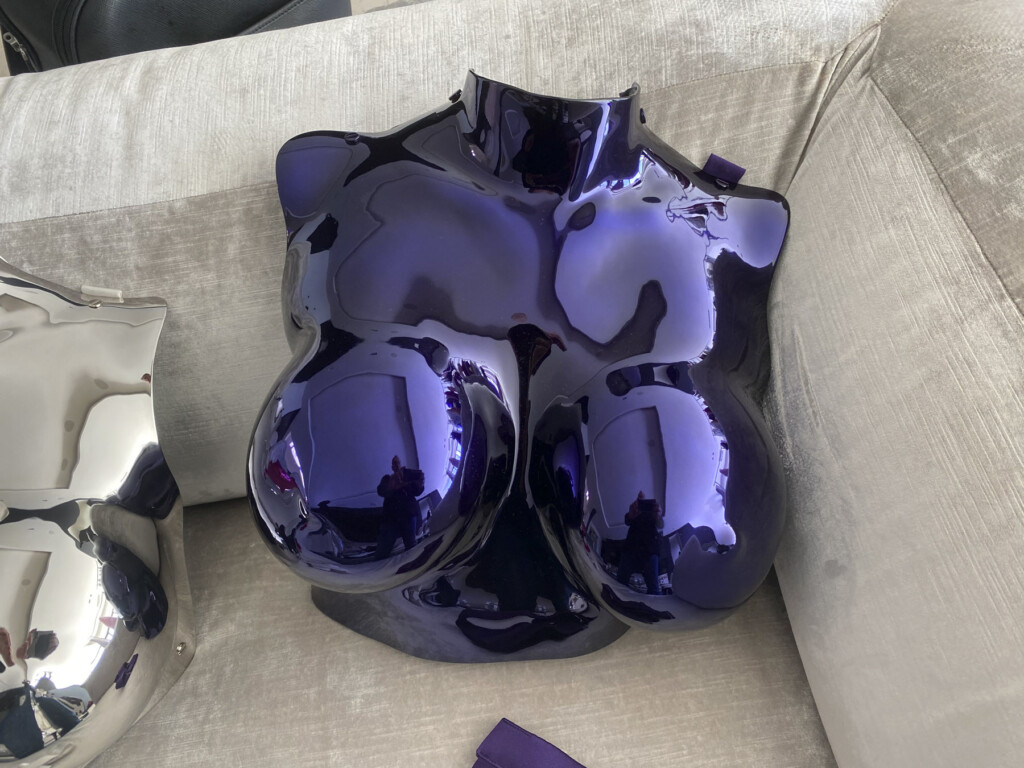
I have to ask, though: How many of my photographer friends out there are already cringing at the thought of lighting these objects?
Their reflective surfaces made them a lighting nightmare. The directional beauty dish with the grid couldn’t be used at all because the reflections would have been impossible. So, we pivoted. We removed the key light and beauty dish and added an 8 x 8 silk in front of the 8-foot Chimera Octabank. That way, the reflections were soft and manageable in post. I like to be as prepared as possible and then be willing to throw it all away if needed. Since the breastplates were so futuristic, I tried to elicit a more otherworldly pose from Desiree.

I never set out to rely on Photoshop or AI to create an image. I would always rather capture as much as possible in camera. At the same time, I won’t resist compositing an image when the concept calls for it, and our main image, mixing parenthood with the life of a chic model, definitely did.
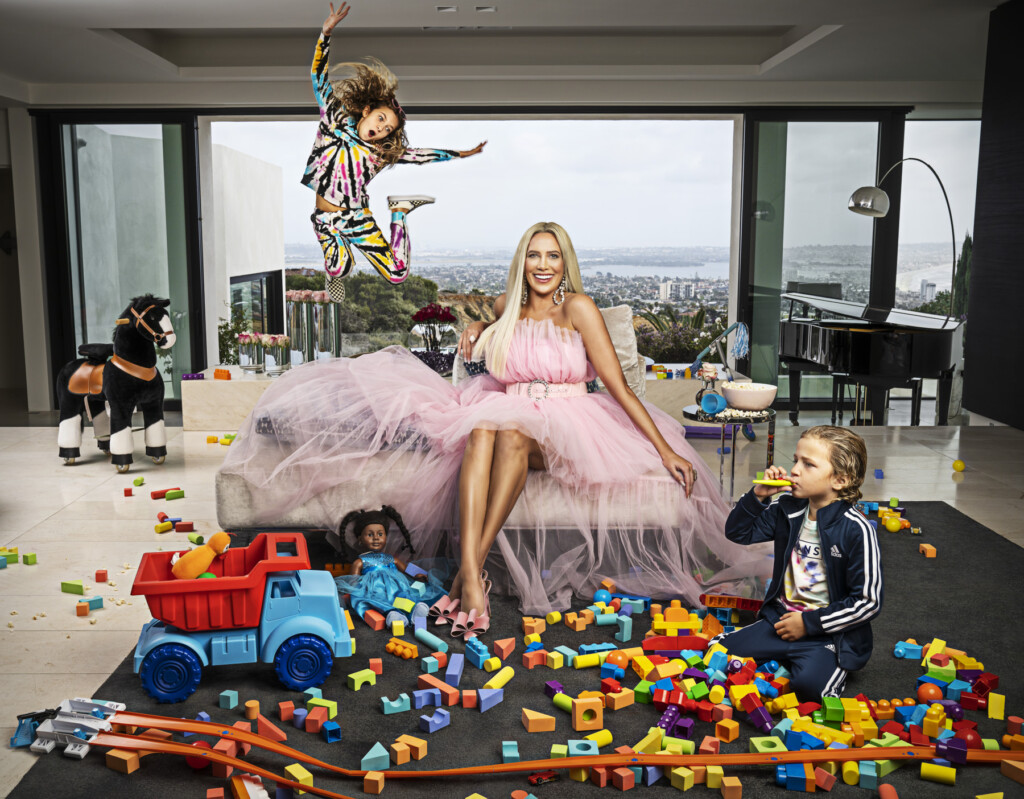
I decided to shoot that image in her living room. It was the biggest space in the house and had a grandiose view. The real issue was all the reflections in the windows, so I chose the simplest solution: I opened them all and positioned the lights to avoid reflections. We used essentially the same lighting setup: a large Chimera Octabank directly behind me and a beauty dish on Desiree. This time, the ratio was much closer in exposure, so the “fill” could actually help illuminate the scene. I also raised the fill and pointed it downward to create a more dramatic angle for the lighting.
We experimented with different outfits and different configurations of toys and kids. We even hid a small trampoline behind the couch so we could capture the chaos of motherhood alongside the beauty of a fashion icon. This became our favorite image overall, except for one thing: her daughter flying through the air.

I realized I had a better frame of just that element, so I substituted her daughter from the stronger frame and composited the final image.
And next time, I’ll get better at taking BTS images, too!
Cheers,
Michael
